d'Eglantier
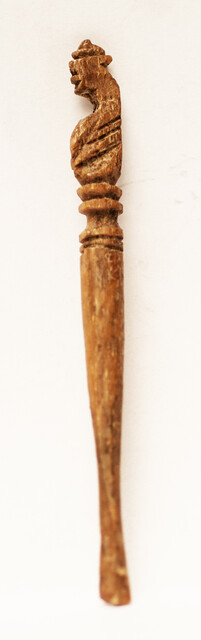
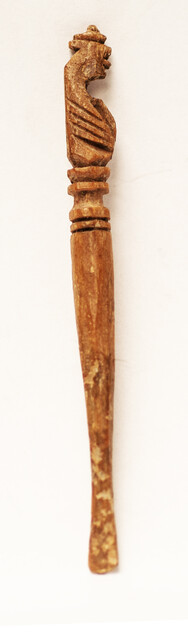
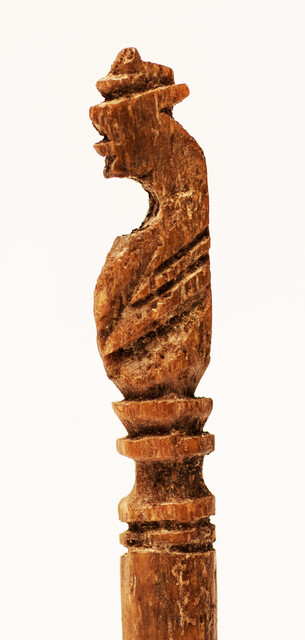
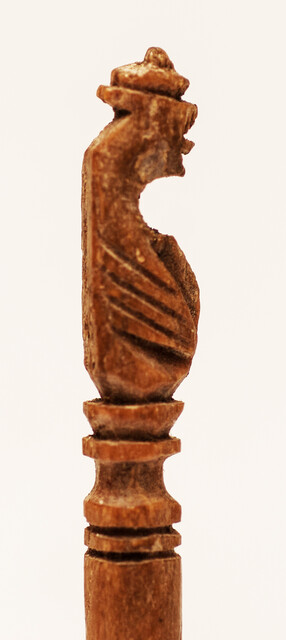
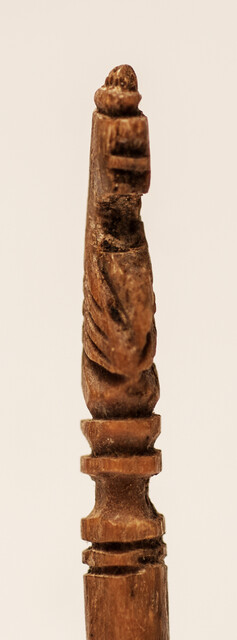
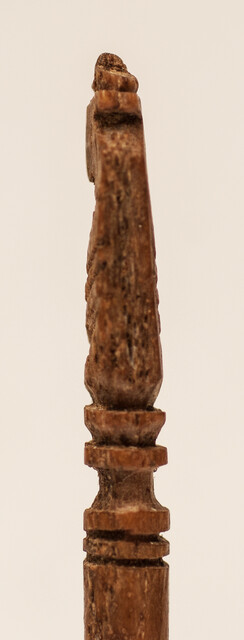
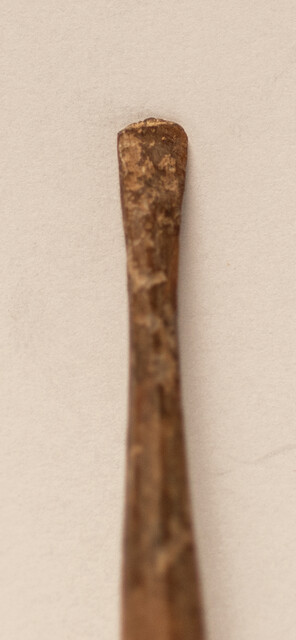
  • A seventeenth century bone ear-spoon crowned by a man with a hat.
  • A seventeenth century bone ear-spoon crowned by a man with a hat.
  • A seventeenth century bone ear-spoon crowned by a man with a hat.
  • A seventeenth century bone ear-spoon crowned by a man with a hat.
  • A seventeenth century bone ear-spoon crowned by a man with a hat.
  • A seventeenth century bone ear-spoon crowned by a man with a hat.
  • A seventeenth century bone ear-spoon crowned by a man with a hat.
  • A seventeenth century bone ear-spoon crowned by a man with a hat.
  • A seventeenth century bone ear-spoon crowned by a man with a hat.
A seventeenth century bone ear-spoon crowned by a man with a hat.

75 €


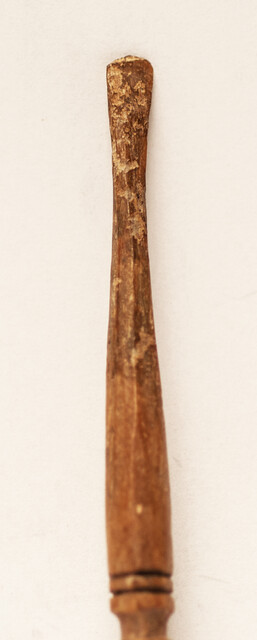
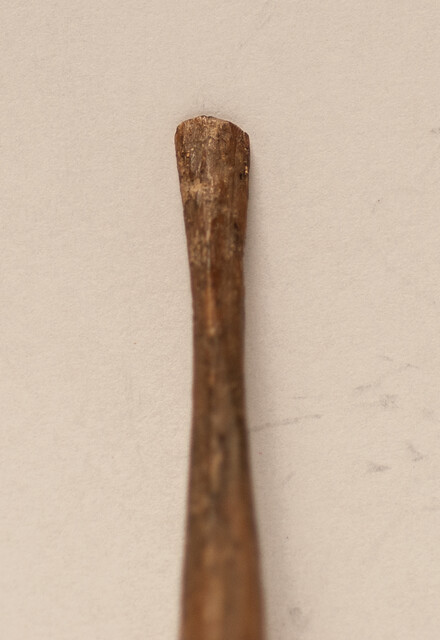
A bone ear spoon. Length 95 mm. With on top a nicely sculptured man wearing a hat. The flat end is rather typical for this type of tool for personal hygiene. This item was found in an ancient exvavation site. It is remarkably well preserved. It was made around 1600.  

Request for more information
See more items of this dealer
Print
d'Eglantier
Address:
Egelantiersgracht 93 ,
1015 RE Amsterdam
Country: The-Netherlands
Tel.: +31 (0)20 6262061
E-mail: info@deglantier.com
Website: www.deglantier.com
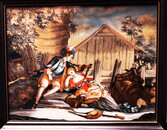
An eighteenth century reverse painting on glass. In a black frame.

An eighteenth century reverse painting on glass. In a black frame.


A reverse glass painting in a frame. Size of the frame: 35 x 28 cm. Size of actual painting 30 x 24 cm. The painting shows a man with a daggar above the heart of a sleeping young lady. On the right a cow. The clothing suggests an eighteenth century origin. On the foreground a stick and the hat presumably belonging to the girl who was most likely herding the animals . There is some loss of paint on the lower right. Otherwise the painting is in good condition. On the back a label of a frame makers firm in Breda.


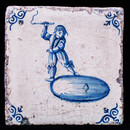
A rare early seventeenth century Delft blue tile with a boy whipping a top.

A rare early seventeenth century Delft blue tile with a boy whipping a top.


A  Delft blue tile. Size 13 x 13 cm. Thickness 12 mm. On the tile a lively image of a boy whipping a top. Quite exceptional is the fact that the top is shown on an oval board. This makes the tile a very rare item. The thickness of this tile makes a date around the first quarter of the seventeenth century quite likely. The tile is in very good condition without damage, repair or restorations.
 

A pair of silver plated 18th Century Dutch church bench candlesticks.

A pair of silver plated 18th Century Dutch church bench candlesticks.


A pair candlesticks. Overall height 9 cm. This pair of quite rare candlesticks was used by well to do owners of a private bench in the church. The candles were meant to enable them to read the bible when there was insufficient light from other sources. This set of silver plated brass candlesticks are in mint condition.

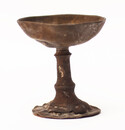
A pewter toy salt cellar from an early 17th century excavation site in a Dutch provincial town.

A pewter toy salt cellar from an early 17th century excavation site in a Dutch provincial town.


A pewter salt cellar. High 5 cm. Upper diameter 5 cm. Diameter foot 4 cm. Pewter with deep black patina. Found in an early seventeenth century excavation site. The very small size almost certainly points to use by a child as a toy. Considering its age in a remarkably good condition.
 

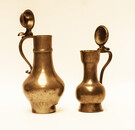
Two 18th Century toy pewter lid jugs with hallmarks.

Two 18th Century toy pewter lid jugs with hallmarks.


Two pewter toy jugs. High 13 and 17 cm. Both hallmarked on the bottom with 18th century hallmarks. Both in mint condition with signs of use. Both with a hinged lid on top. Holland eightteenth century. This type of toy still in good condition is extremely rare.

An 18th Century pewter Dutch porridge bowl hallmarked with a rose and initials

An 18th Century pewter Dutch porridge bowl hallmarked with a rose and initials "E.R.".


A pewter porridge bowl. Length (without handles) 14 cm. With handles 25 cm. Height 5 cm. Hallmarked with a rose and "E.R.". In mint condition. Holland, eightteenth century.
 

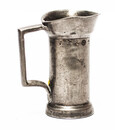
An 18th century pewter measuring can of 50 cc with various hallmarks.

An 18th century pewter measuring can of 50 cc with various hallmarks.


A pewter measuring can. High 8 cm. Wide 5 cm. Weight 200 gram. Contains 50 cc. With 5 hallmarks just below the rim. In mint condition. Holland, late 18th century.
 

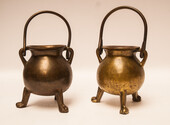
Two early 18th century heavy bronze cauldrons.

Two early 18th century heavy bronze cauldrons.


Two cauldrons. High (without iron handle) 12 cm. Weight 6 kilogram. The cauldrons are clearly hand made in solid bronze with irregular openings. Both resting on three feet. The handles are made of wrought iron. Both cauldrons in mint condition with signs of use in open fire. Low Countries, around 1700.
 

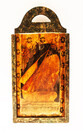
A Frisian schoolbox decorated with a sailing ship.

A Frisian schoolbox decorated with a sailing ship.


A schoolbox. Measuring 43 x 21 x 8 cm. On the lid a sailing ship. Further the typical stencilled roses around the ship. This type of schoolbox was made in the area of IJlst in Friesland. Made around 1850. The box is in mint condition with an old repair to the lid. On the inside of the lid the name of its owner : "S.M.Sijsma".
 

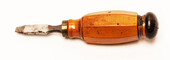
A superb boxwood screwdriver in mint condition.

A superb boxwood screwdriver in mint condition.


A screwdriver. Overall length 14 cm. Length of handle 9 cm. The handle is entirely made of boxwood with an ebony screw on cap. The handle marked "2" and the metal part "P2". On the brass ring separating steel and handle the same "P2" mark. The screwdriver is in mint condition and was made in Holland around 1850. 
 

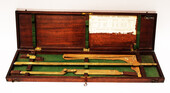
A brass precision set for measuring fluid content by Jan Marten Kleman Amsterdam (1758-1845).

A brass precision set for measuring fluid content by Jan Marten Kleman Amsterdam (1758-1845).


A set of measuring instruments in a mahogany box. Size 58 x 17 x 3,5 cm. Signed J.M.Kleman & Son Amsterdam. All parts numbered " 12 ". The set is complete and in superb condition. Kleman had his shop in Amsterdam between 1758 and 1845 on the Nieuwendijk 126 in Amsterdam. He was famous for his precision instruments. Also abroad. The present set belonged to the official Hallmark Office and their label is also present in the box. It was used for measuring contents.
 

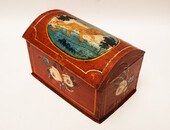
An eightteenth century German painted box with

An eightteenth century German painted box with "Wismuth Malerei" featuring a lion in a landscape.


A painted wooden box. Long 25 cm. Wide 16,5 cm. High 16,5 cm. On the convex lid a delicate painting of a lion in a landscape with trees. On all sides a painting of flowers. The inside is also painted in red. The box is in good condition with minor signs of use. This type of decoration is called "Wismuth Malerei" because of the use of the chemical element "Bismuth". Bohemia, 18th century.